REVIEW · OAHU
Private 1-on-1 Surf Lesson with Videos and Photos
Book on Viator →Operated by Manifesting Aloha Surf School · Bookable on Viator
First-timers and nervous surfers usually leave grinning. This private Honolulu surf lesson is built around 1-on-1 coaching and a clear path from safety basics to getting your board moving, with the instructor right there beside you. I especially like the same-day photos and videos, so your progress doesn’t vanish the moment you change out of your wetsuit. The main thing to consider is that it’s weather-dependent and you’ll need a moderate fitness level for an hour in the water.
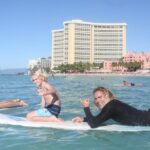
You’ll meet at Manifesting Aloha Surf School at Duke Kahanamoku Lagoon, where it’s easy to find the ocean access near a small triangular beach. After a quick demo right near the water entrance, you move into hands-on practice: paddling help, pop-up coaching, and wave support. Instructors like Jake (a name that comes up a lot in past sessions) are known for being patient, calm, and very focused on getting you comfortable, fast.
In This Review
- Key Points Worth Knowing Before You Go
- Where You Meet in Honolulu: Duke Kahanamoku Lagoon Setup
- The 1-Hour Surf Lesson Flow: From Demo to Catching Waves
- Paddling, Pop-Ups, and the Safety Rules You’ll Actually Use
- The Guarantee: What It Really Means for First-Timers
- Equipment Included in Honolulu: Rash Guard, Shoes, Board, Leash
- Photos and Videos Sent Same Day: Your Proof of Progress
- Price, Timing, and Why Booking Ahead Matters
- Diamond Head, Waikiki, and Honolulu: How to Think About the Listed Stops
- Who This Private Lesson Is Best For (and Who Should Reconsider)
- Should You Book This Private Surf Lesson in Honolulu?
- FAQ
- How long is the private surf lesson?
- Is this a private 1-on-1 lesson?
- What ages can surf?
- What’s included with the lesson?
- When will I receive the photos and videos?
- Will I catch a wave if I’m a beginner?
- What if the weather is bad or I need to cancel?
Key Points Worth Knowing Before You Go
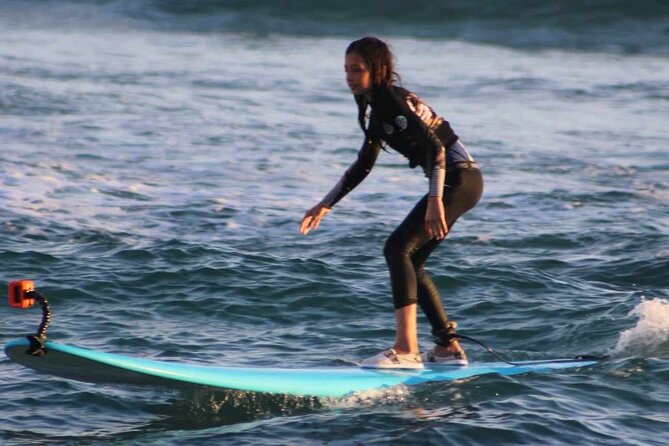
- Guaranteed wave time: You’re promised to catch a wave even if you start by riding on your stomach.
- Real 1-on-1 instruction: Only your group participates, with the instructor next to you the whole session.
- Kids can surf too: Ages 4+ are welcome, and kids 4–11 can choose tandem surfing with the instructor.
- Safety and technique, not just random standing: You practice paddling, pop-ups, and basic surf safety rules.
- Help on the water: If paddling is hard, you get instructor support (including towing/pushing when needed).
- Same-day keepsakes: Photos/videos are uploaded the same day, with an email sent by evening.
Where You Meet in Honolulu: Duke Kahanamoku Lagoon Setup
This lesson is centered on the Honolulu ocean near Duke Kahanamoku Lagoon (Honolulu, HI 96815). The meetup point is at the end of a parking lot by the ocean, next to a small triangular beach. That matters more than it sounds, because surf lessons live or die on location accuracy, show up in the wrong spot and you waste the best part of your energy.
When you arrive, you’ll get to choose the water shirt size and water shoes before you head into the water. That’s a practical touch: in surf sessions, fit affects comfort and balance. If your shoes are too loose or too tight, your feet fatigue faster and everything feels harder.
The lesson is close to public transportation, so you’re not locked into a car. You should still plan on getting there with enough buffer time so you can get your gear sorted calmly. For gear, included items cover the surf essentials: board, leash, rash guard (water shirt), and water shoes, so you’re not hunting down rentals or packing your own.
You can also read our reviews of more private tours in Oahu

The 1-Hour Surf Lesson Flow: From Demo to Catching Waves
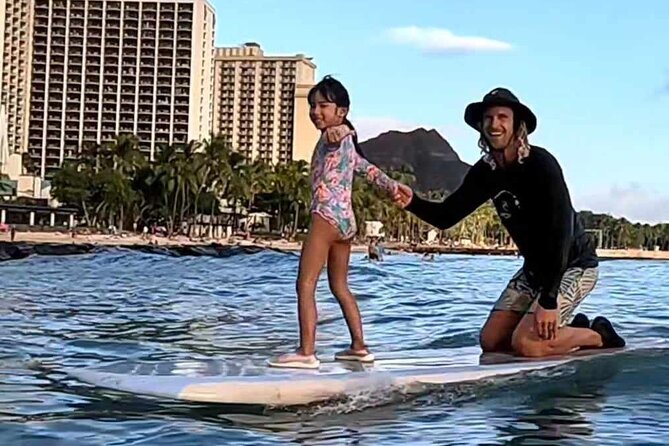
Plan on about one hour total in the water-based lesson (approx.). The flow is straightforward and built for beginners, especially if you’re worried about safety or you’re not sure what to do once you’re out there.
1) You start with a demo near the entrance of the water.
This part is where you learn what the experience actually feels like. You’ll get a safety walkthrough, plus guidance on paddling, pop-ups, and common questions before you’re out in the harder-to-reach zone.
2) Then it’s practice with constant instructor support.
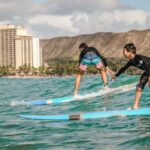
You spend the rest of the session working on paddling, standing up, and catching waves. If you struggle to paddle on your own, instructors will tow you to help you keep moving toward the wave. If you need extra confidence, they can push you so you get comfortable with catching waves.
3) You finish back at the shore and get your photos/videos quickly.
Once you return, you don’t have to wait days to feel like your trip happened. Your media is uploaded the same day, and you get an email by that evening.
Because it’s private 1-on-1, the instructor can adjust to your pace. That’s a big deal for kids, anxious surfers, and adults who want clear feedback instead of guessing what someone else in a group is doing.
Paddling, Pop-Ups, and the Safety Rules You’ll Actually Use
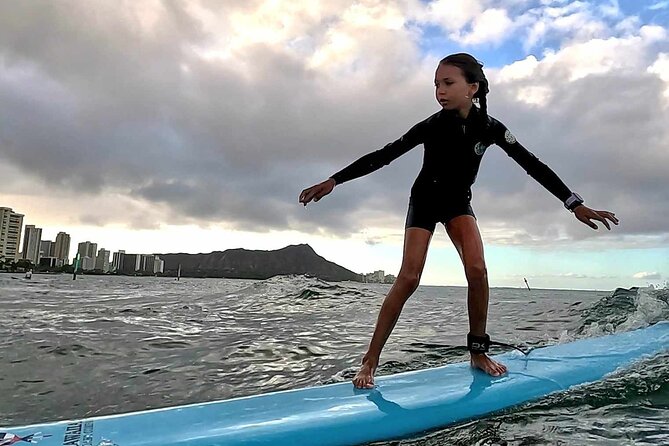
A good beginner surf lesson doesn’t just teach you to stand. It teaches you to move safely through surf conditions and read what’s happening in front of you.
Here’s what this lesson focuses on:
- Safety rules: You’ll get practical instructions before you head out, so you know what matters (and what doesn’t) while you’re in and around the water.
- Paddling technique: If paddling is your sticking point, you’re not left to flail. You’ll get instructor help, including towing if you need it.
- Pop-ups: You practice the movement that turns lying on the board into standing. This is where the instructor’s presence helps, small corrections can make the difference between wobbling and actually getting up.
- Surf etiquette basics: Instructors tend to explain how to behave around other surfers and how to position yourself, so you’re not just learning technique, you’re learning how to share the space.
And here’s the emotional win: if you’re nervous, your brain usually gets loud when you’re cold or out of breath. Having an instructor next to you, explaining what comes next, turns fear into a checklist you can follow.
For younger kids (age 4–11), tandem surf is an option. That can be huge if you want the fun of being on a wave without the full load of doing every step alone.
The Guarantee: What It Really Means for First-Timers
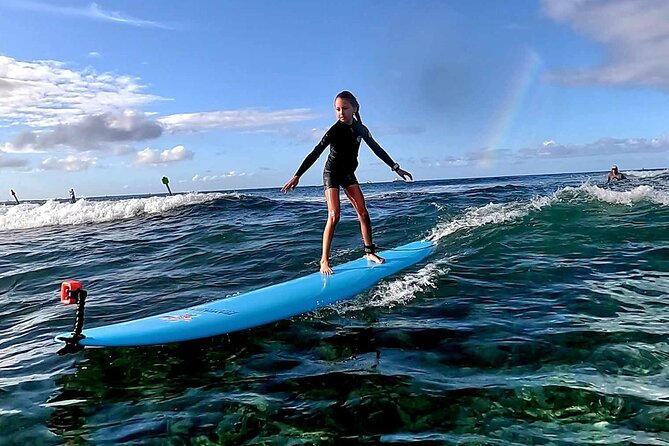
The guarantee is simple: you’ll catch a wave, even if it’s on your stomach at the start.
That detail is important because it tells you what the lesson is optimized for. You’re not paying for a lesson where success depends on luck and strength. You’re paying for instruction plus physical help when needed.
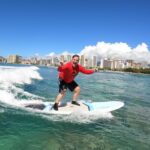
Most beginners also catch multiple waves standing during their first beginner lesson. That doesn’t mean everyone will stand in every single attempt, but it does mean the coaching and wave support are designed to get you rolling through a few wins instead of just one.
If you’ve got specific worries, like fear of the water, uncertainty about paddling, or feeling like the ocean is bigger than you, this is the kind of lesson where support reduces the hardest part. One of the most frequent themes in instruction style is patience: the instructor stays encouraging, keeps things organized, and helps you feel safe even when you can’t control every moment.
If you’re the type who learns best by doing in short, guided tries, you’ll likely love the rhythm here: instruction near the water entrance, then repeated practice until you start to get your timing right.
Equipment Included in Honolulu: Rash Guard, Shoes, Board, Leash
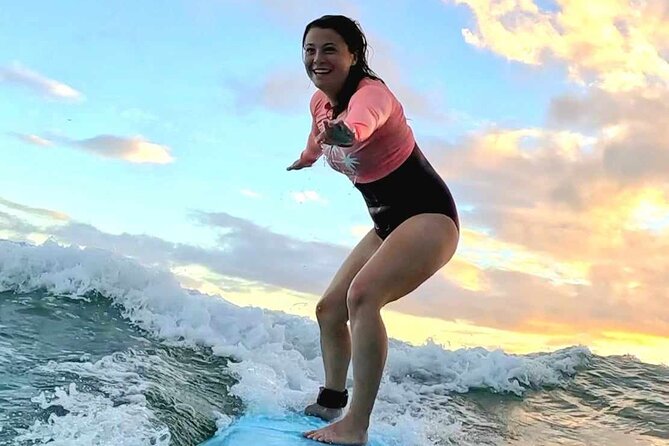
The lesson includes the surf setup you’d normally have to rent. That matters because you can show up without turning your trip into a gear hunt.
Included:
- Surf board
- Leash
- Water shirt (rash guard)
- Water shoes
A few practical notes:
- Water shoes help with foot protection and grip, especially on any uneven entry zones.
- The rash guard reduces irritation and friction, which helps you focus on paddling and pop-ups instead of adjusting constantly.
- The leash is part of surf safety, your instructor will make sure you understand the basics so you’re using it correctly.
The ability to choose the water shirt and water shoes size at the start is a small detail that can save your entire session from becoming uncomfortable. If you’ve surfed before and your gear choices are already dialed in, you still benefit from using their provided setup.
You can also read our reviews of more photography tours in Oahu





Photos and Videos Sent Same Day: Your Proof of Progress
This is one of the biggest reasons people leave with a better memory than just a wave story.
After the lesson, your photos and videos are uploaded the same day, and you receive an email by evening. That means you’re not waiting for a souvenir month later. It also means you can watch what you did while it’s still fresh, useful if you’re thinking about improving next time.
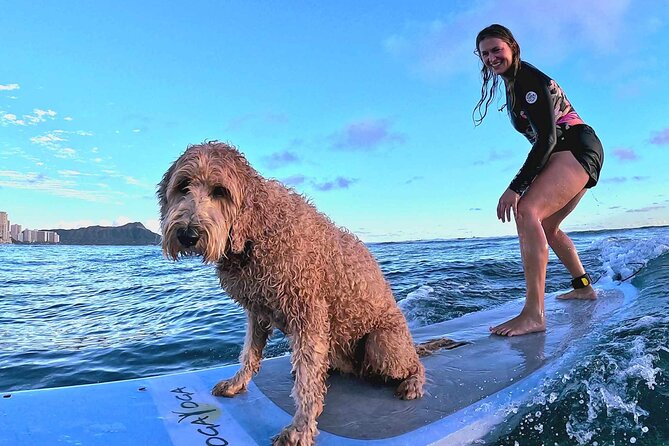
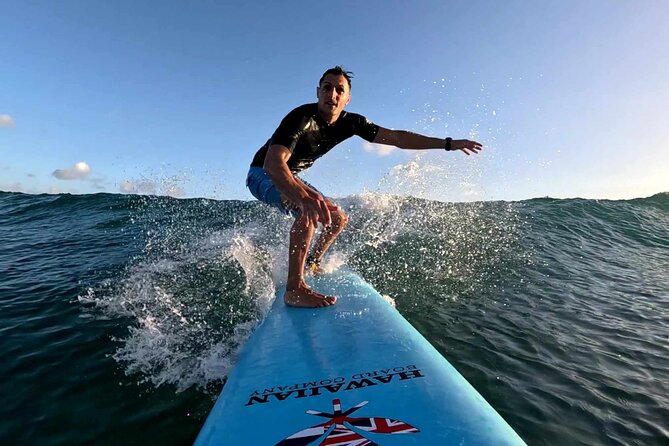
Expect lots of coaching shots, not just distant scenery. The instruction model is hands-on, so the media usually captures the moments you’re most likely to remember: paddling rhythm, pop-up attempts, and those first real catches.
If you’re surfing with kids, this part hits even harder. When kids are in the water, the parents’ brains often scramble trying to track everything at once. The photos and video become a second set of eyes.
And if you’re a fearful surfer, seeing yourself actually ride can flip your internal story from I was scared to I did it. That’s not a small thing.
Price, Timing, and Why Booking Ahead Matters
The price is $160 per person for a private session, with duration about one hour. That sounds like a premium cost, and it is. But private instruction is also the highest-contact format: you’re paying for focused coaching, equipment handling, on-water help, and a tailored pace.
A private lesson tends to be best value when:
- you want faster learning without crowd-based waiting,
- you’re traveling with kids and want one-on-one attention,
- you’re nervous and want support,
- you care about getting photos/video right away with clear action.
You can also plan around demand. This experience is often booked about 38 days in advance, which tells you it’s popular for a reason. If your travel window is tight, locking it in early makes your schedule easier.
Also keep in mind what’s not included: gratuities/tips aren’t part of the price. That’s standard for private guides, but it’s worth budgeting so it doesn’t surprise you later.
Diamond Head, Waikiki, and Honolulu: How to Think About the Listed Stops
The itinerary lists Diamond Head Crater, Waikiki, Honolulu, and Oahu. For you as a surfer, the key takeaway is this: the experience stays rooted in the Honolulu/Waikiki area rather than taking you far out on a multi-hour excursion.
So when you’re planning your day, think of this as an Oahu surf experience that uses local landmarks in its route context, with the main event happening right at your ocean meeting point near Duke Kahanamoku Lagoon.
If you’re trying to stack surf with other Honolulu activities, this is the type of lesson that usually fits best in a half-day plan rather than deep into a full day itinerary. Surf involves cold water time, entry and exit logistics, and then you still get the media that evening.
Who This Private Lesson Is Best For (and Who Should Reconsider)
This lesson is designed for beginners and for people who need close coaching.
It’s a strong match if:
- you’re age 4 or older (and especially if you’re bringing kids),
- you want private 1-on-1 instruction rather than group dynamics,
- you’re nervous and want an instructor who stays patient and close by,
- you want to learn safety, paddling, and pop-ups with real feedback,
- you want a good chance at catching waves quickly.
It may be less ideal if:
- you can’t participate with moderate physical fitness, since you’ll be in the water and doing paddling/pop-up practice,
- you get easily frustrated by physical effort (surf tries can feel tough before they feel fun),
- you’re going on a day you suspect weather could be rough, this experience needs good weather.
There’s also a note on pets: a dog surf lesson is for pets, not service animals, unless your service animal is capable and truly likes being in the ocean. If that’s relevant for you, clarify expectations ahead of time.
Should You Book This Private Surf Lesson in Honolulu?
If you want a surf lesson where the instructor is right there with you and your odds of success aren’t left to chance, I’d book this. The guarantee to catch a wave, the hands-on coaching (including support when paddling is tough), and the same-day videos/photos combine into a great value for the money, especially for kids and fearful first-timers.
If you hate waiting, dislike crowded group lessons, or want clear instruction with quick feedback, private is the smart call. Just plan for weather, wear comfortable water-ready layers, and show up ready to learn fast.
If that all sounds like your kind of day, you’ll likely walk away with more than a story, you’ll have proof on your phone by evening.
FAQ
How long is the private surf lesson?
The lesson is about 1 hour (approx.).
Is this a private 1-on-1 lesson?
Yes. It’s private and only your group participates.
What ages can surf?
The lesson is for age 4 and older. Ages 4–11 may choose to tandem surf with the instructor.
What’s included with the lesson?
You get a surf board, leash, water shirt (rash guard), and water shoes, plus all fees and taxes. You also receive a photo/video package sent by email after the lesson.
When will I receive the photos and videos?
Photos and videos are uploaded the same day, and you’ll receive an email by that evening.
Will I catch a wave if I’m a beginner?
Yes. You’re guaranteed to catch a wave, even if you ride on your stomach. Most beginners also catch multiple waves standing in a first beginner lesson.
What if the weather is bad or I need to cancel?
This activity requires good weather. If it’s canceled due to poor weather, you’ll be offered a different date or a full refund. You can cancel for a full refund up to 24 hours in advance.