REVIEW · HONOLULU
History & Culture Tour in Honolulu via Segway
Book on Viator →Operated by Segway of Hawaii - Kakaako · Bookable on Viator
A great way to cover downtown fast. This History & Culture Tour turns big Honolulu landmarks into a guided ride, with you gliding past Mission Houses, Kamehameha’s statue, and Iolani Palace while your guide narrates what mattered and why. I really like the two-way radio headsets, which keep instructions and commentary clear, and the route that strings together major sites without the constant stopping and starting of a walking tour. One thing to consider: you’re spending a lot of time outdoors riding between stops, so strong sun, heat, and crowd levels can affect comfort.
The small group size also helps a lot. With a max of 8 people, you get more back-and-forth time, and the vibe is easy even if it’s your first Segway; guides such as Jeanne and Michael are specifically praised for safety and making riders comfortable. Still, the Segway is the main “transport,” so if you want long indoor museum time at each stop, this format may feel more like seeing the grounds than doing a deep museum day.
In This Review
- Quick hits before you clip in
- Segway + storytelling: why this route feels efficient
- Start at Kaka’ako: getting oriented fast at Segway of Hawaii
- Mission Houses and Kawaiahao Church: the beginning of a new era
- What to watch for at this stop
- King Kamehameha statue and the Supreme Court setting
- Iolani Palace grounds and the Queen Lili’uokalani moment
- Practical tip
- Government architecture next: Capitol Building and the Art Museum area
- Chinatown and the smell of everyday life: markets and noodle factories
- Bishop Street and Merchant Street: Honolulu’s older “money streets”
- One consideration
- Aloha Tower and Honolulu Harbor: history you can feel
- Kaka’ako waterfront and Point Panic surfers: the ocean energy finale
- End at Ala Moana: a clean finish along the beach
- Gear, group size, and safety: what matters most day-of
- Price and value: is $254.14 worth it?
- Who should book this Segway history-and-culture tour
- Should you book the Honolulu History & Culture Segway tour?
Quick hits before you clip in
- Two-way radios/headsets help you hear the guide clearly while you ride.
- Max of 8 people keeps the tour feeling personal and controlled.
- A tight downtown-to-harbor route covers Mission Houses, Iolani Palace, Chinatown, Aloha Tower, and Kaka’ako.
- Harbor + ocean finale means you get a different Honolulu mood near Aloha Tower and Ala Moana.
- Photo stops are built in at major statues and vantage areas.
- Waikiki transfers cost extra, so plan for the meet-up point if you’re already on your own schedule.
Segway + storytelling: why this route feels efficient
Honolulu downtown can be a lot to sort out in a short time. This tour is designed for that reality. In about 2 hours 30 minutes, you ride between key historic areas, mission-era sites, royal landmarks, government buildings, Chinatown, and the harbor, without burning your day on long walks and traffic waits.
The Segway matters here because it changes what you can do with your time. You can cover the distances between places like King Kamehameha’s statue, Iolani Palace, and Honolulu Harbor, while still hearing the story through your headset. That’s the practical magic: you get motion plus context, so you’re not just sightseeing. You’re connecting the dots.
You can also read our reviews of more historical tours in Honolulu


Start at Kaka’ako: getting oriented fast at Segway of Hawaii

The tour starts at Segway of Hawaii – Kaka’ako Store, Keer Building, 1687 Kalauokalani Way. Meeting back at the same place is simple, and the schedule starts at 9:00 am, which is usually a good way to dodge some of the later heat.
If you’re staying in Waikiki, you can add round-trip transfers from Waikiki to Kaka’ako for $20 per person. That costs extra, but it’s a clean option if you don’t want to manage a bus or taxi right before a 2.5-hour ride. Either way, the good news is the start point is near public transportation, so you’re not trapped into the transfer.
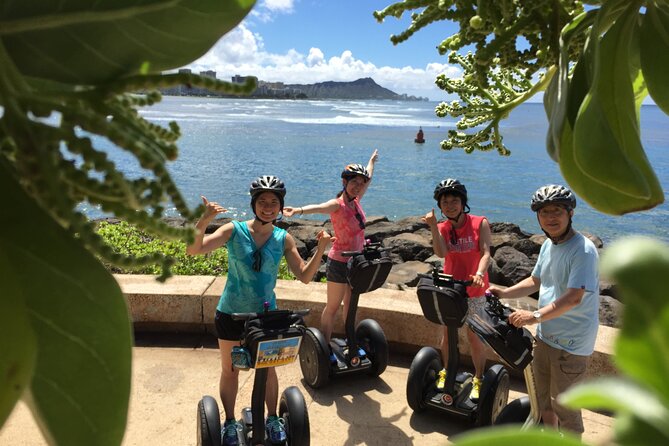
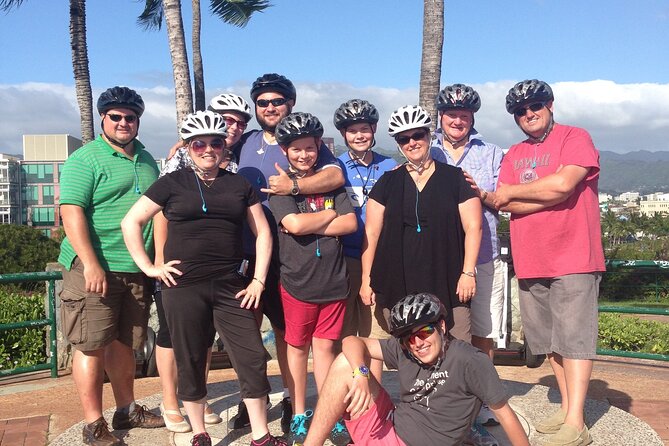
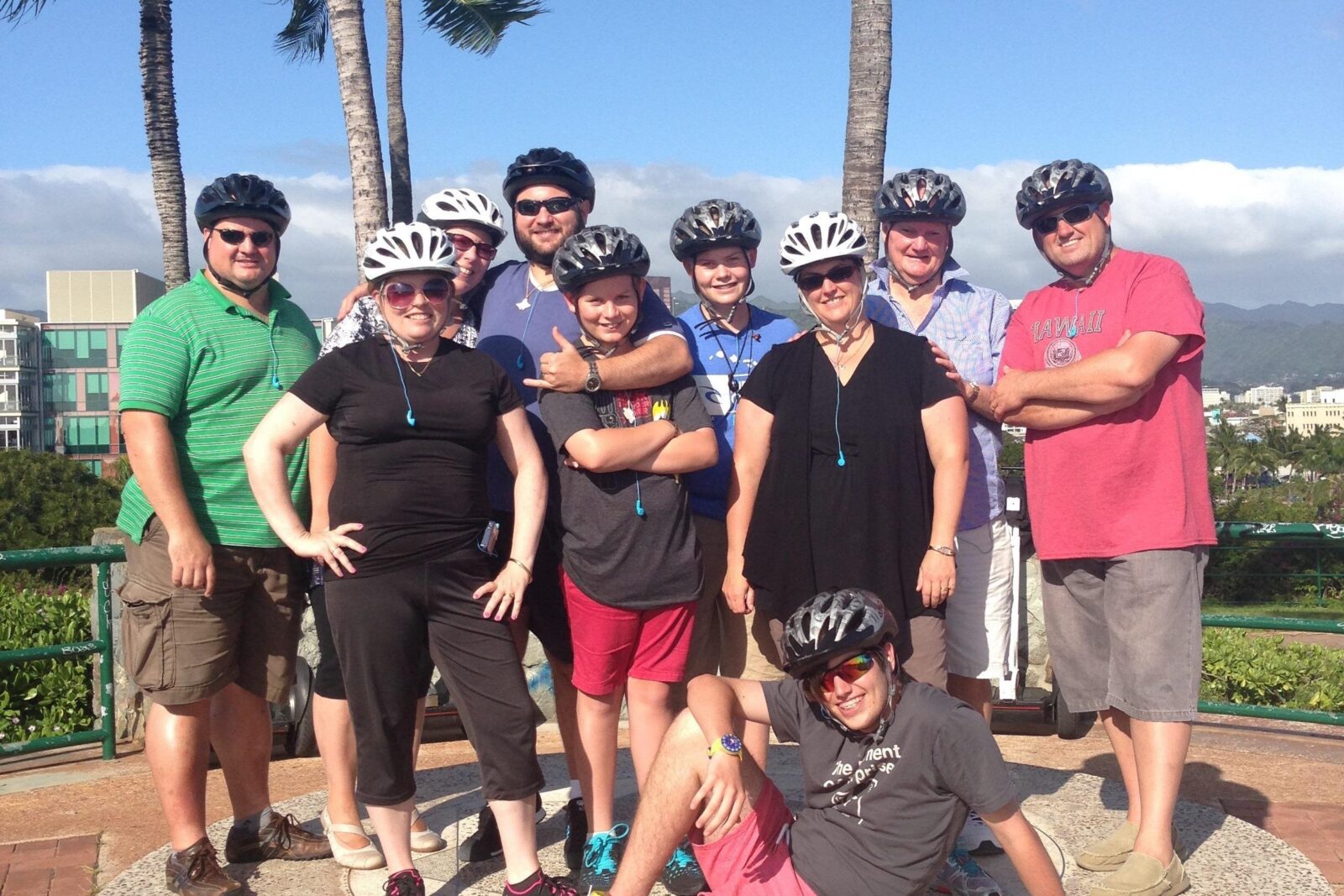
Before you roll out, you’re set up with the basics that make this tour work: a colorful helmet, plus the two-way headset so you can hear the guide and communicate as needed. This is one of the biggest reasons reviews lean so positive on safety and comfort.
Mission Houses and Kawaiahao Church: the beginning of a new era
The first stop is a cluster of austere buildings at the Mission Houses area, built in 1820 by Hawaii’s first missionaries. Even before you’re thinking about famous monarchs or later politics, this is where you start to understand how quickly Honolulu’s world began changing. You’ll also see Hawaii’s first church next door, also built in 1820, along with the historic Kawaiahao Church and its graveyard.
That graveyard element is an emotional anchor. The tour points out that many of Hawaii’s former Ali’i (royalty) are buried here. In other words, you’re not just looking at old architecture. You’re standing near a place where status, legacy, and history overlap.
Across King Street, you also spot Honolulu Hale (City Hall). It’s a reminder that today’s government life sits on top of layers of older Honolulu, first missionary-era shifts, then later national and royal eras, and finally modern civic structures.
What to watch for at this stop
- This is a good orientation stop: you’ll understand the route layout before you speed up between landmarks.
- Wear sunscreen; early stops are often still in open areas with lots of glare.
King Kamehameha statue and the Supreme Court setting
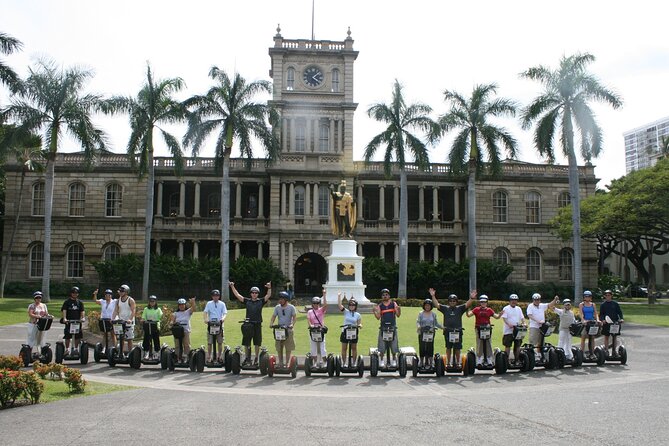
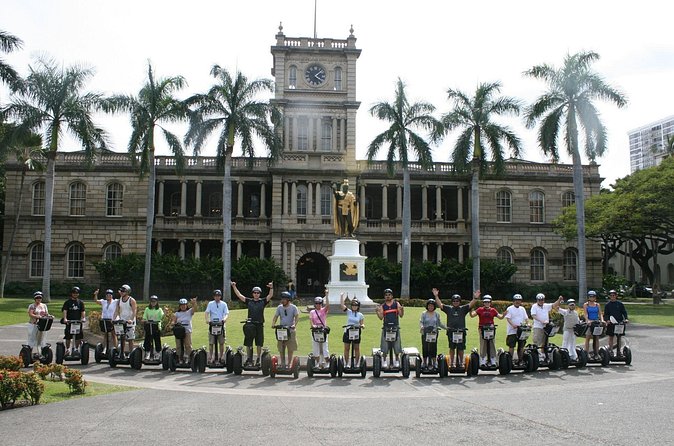
Next, you glide to the gold-encrusted King Kamehameha Statue, one of three statues in the world. It’s positioned in front of Hawaii’s State Supreme Court building, which was once the seat of Hawaii’s government when the islands were a nation.
That pairing matters. The statue isn’t isolated; it’s placed where power made decisions. So the guide’s narration helps you read the symbolism: leadership, nationhood, and governance all on the same visual axis. And because you’re on a Segway, you can move from this moment to the next landmark without losing momentum.
If you like photo stops, this is a likely “get your angle” moment. The gold details catch light, and the statue’s placement against government buildings makes it a strong backdrop.





Iolani Palace grounds and the Queen Lili’uokalani moment
This is one of the tour’s core stretches. You cross King Street and enter the grounds of Iolani Palace and Royal Barracks. The tour highlights that Iolani Palace is the only palace on American soil built by King Kalakaua, and today it operates as a museum.
Instead of a long interior museum visit, this part works as a guided exterior loop. You glide around the palace grounds, checking out the banyan trees, then you stop at the Queen Lili’uokalani Statue. Queen Lili’uokalani was Hawaii’s last ruling monarch, and the tour points to the Americans overthrew her government and the Hawaiian Nation.
That story can feel heavy, but the framing makes it easier to process. You’re not hearing it in a vacuum. You’re looking at the actual place tied to royal authority and witnessing how that authority was challenged and replaced.
Practical tip
If you want extra time for palace interiors, plan to add that on your own. This tour seems built to give you the bigger route and key outdoor vantage points, not a full museum day.
Government architecture next: Capitol Building and the Art Museum area
After Iolani Palace, you head toward Hawaii’s State Capitol Building, described here for its unique architecture. You’ll also pass the State Art Museum and move along the historic Hotel Street corridor.
This segment gives you a shift in pacing. You’re moving from a royal narrative into government institutions and public-facing architecture. If you like seeing how different eras leave physical fingerprints, this stretch helps connect what you just learned to how modern Honolulu operates.
Hotel Street is also a useful bridge into Chinatown. The tour uses this corridor to set up the sense that different communities have always been close together in Honolulu.
Chinatown and the smell of everyday life: markets and noodle factories
Then you roll into Chinatown’s shopping mall area, where the tour mentions noodle factories, open markets, and a mix of people from all over the world.
This is a very different vibe from the statues and palace grounds. Instead of monuments, you’re seeing street-level commerce and everyday culture. Even if you’re not stopping for a full meal, the quick look helps you understand Chinatown as a living district, not a theme park stop.
Because you’re on a Segway, you get a guided pass through the busiest visual cues without getting stuck in slow walking lines. The guide also has the chance to explain how these areas fit into the wider Honolulu story you’ve already been hearing.
Bishop Street and Merchant Street: Honolulu’s older “money streets”
From Chinatown, you head to Honolulu’s ‘Wall Street’, Bishop Street, and then to Merchant Street, described as the first paved street in Honolulu. The tour notes artistic buildings and historic transportation buildings that are more than 150 years old.
This part works best if you enjoy “micro-history,” meaning you notice the details around you and the guide helps you interpret them. The idea of Bishop Street as Wall Street gives you a modern comparison point, then the age of Merchant Street and the old transportation buildings adds depth.
It’s also a nice shift in scenery. You’re moving from food-market energy into architecture that feels older and more institutional, still active, but with a longer timeline.
One consideration
These areas can be visually dense. Put your phone camera to work, but listen through the headset first. The guide’s explanations make the buildings more than just photo backdrops.
Aloha Tower and Honolulu Harbor: history you can feel
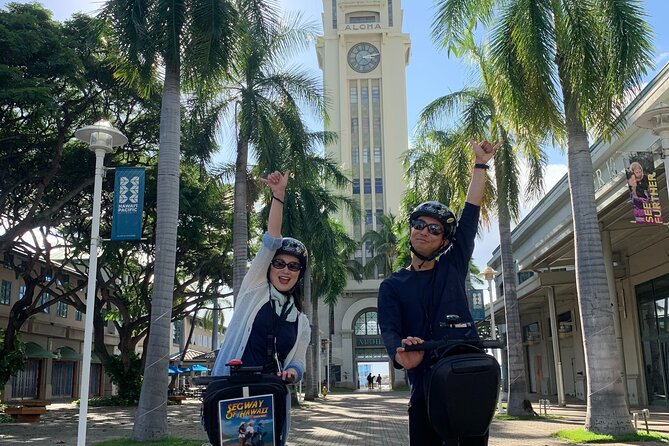
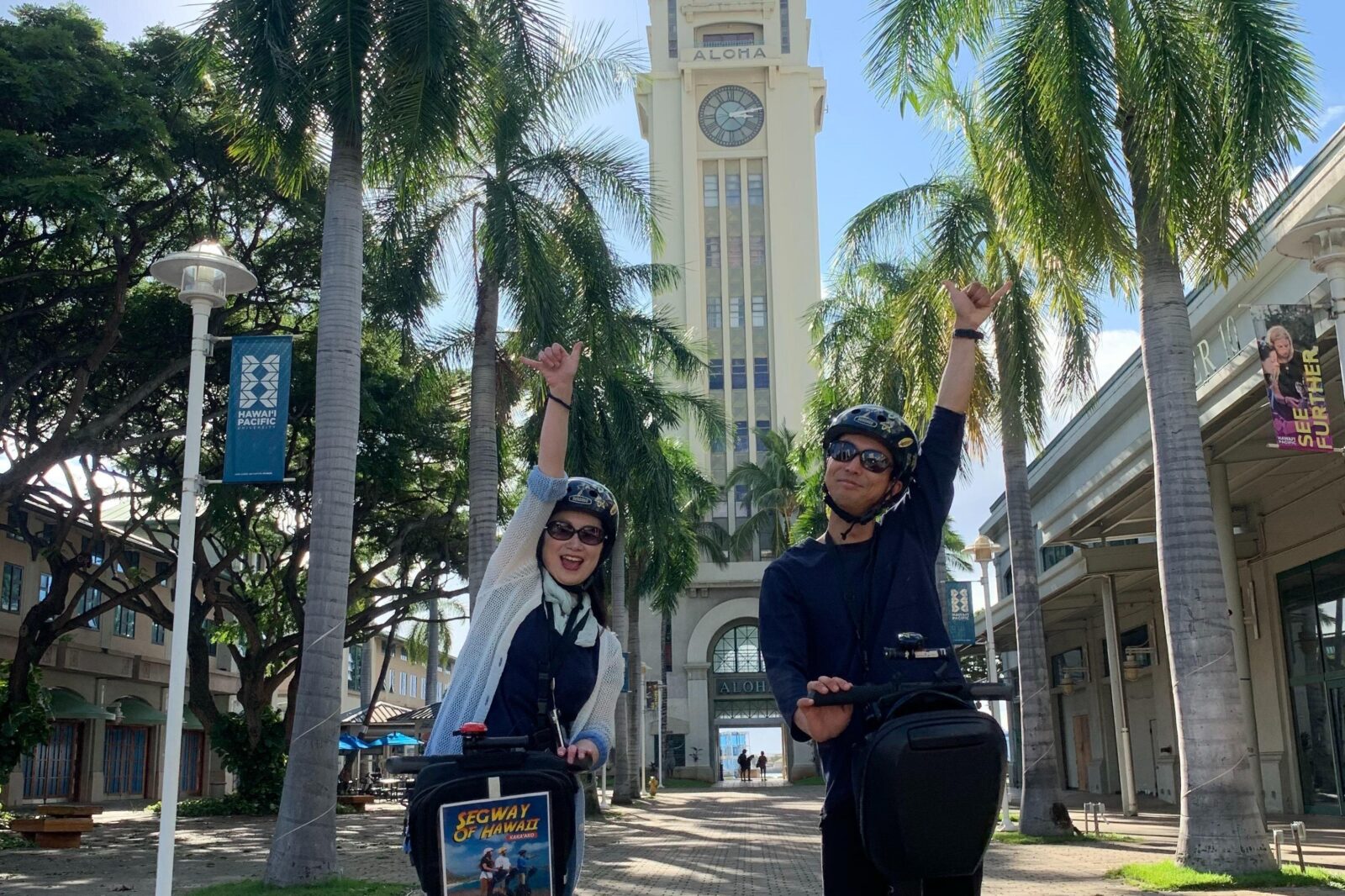
Next up is Honolulu Harbor and the famed Aloha Tower. It was built in 1926 and was the tallest building in Hawaii at the time. Seeing this kind of landmark from the waterfront gives you a sense of how trade, arrivals, and maritime power mattered in Honolulu.
The tour also includes a look at restored coral reef and fish that come to feed close by. That’s a rare add-on in a city-focused history tour: a hint of ocean ecology mixed into the built-environment story.
This segment is also where the tour’s “ride-and-learn” formula pays off. The route gives you both the landmark moment (Aloha Tower) and the nearby living-water detail, without forcing you to choose between history and the ocean.
Kaka’ako waterfront and Point Panic surfers: the ocean energy finale
After the harbor, you glide back toward the ocean and head to Kaka’ako Waterfront Park and its Promenade. The tour points out surfers at Point Panic, which adds a current-of-today Hawaii feel right as the day’s story is wrapping.
Then you ride up the hill to see the Ehime Maru Memorial and the Echo Stone. That mix of memorial space and ocean-adjacent landmark creates a reflective tone. You get to feel the city’s past and present at the same time: remembered tragedy and ongoing daily coastal life.
Even if you’re not a surfer, Point Panic is a fun visual moment. And the hill stops break the pace so you’re not just gliding flat the whole time.
End at Ala Moana: a clean finish along the beach
The tour returns toward the meeting point by riding along the ocean in Ala Moana Regional Beach Park. Ending this way is smart. It’s a natural way to close out a route that began in historic civic buildings and ended with open-air water views.
At this stage, you’ll likely feel what the Segway format is doing for you. You didn’t have to “earn” every mile with your feet, but you still moved through real parts of Honolulu where people actually live and work.
Gear, group size, and safety: what matters most day-of
This tour includes bottled water, plus the helmet and the two-way radio headset. That might sound like standard tour gear, but it changes your experience. Headsets keep you from turning into a speed-walking eavesdropper at every stop.
The group size, maximum 8, also matters in a practical way. With fewer people, the guide can manage transitions and keep everyone together. One review highlight specifically praised that nobody got lost at the end during the single-file riding.
If you’re new to Segways, you’ll also find reassurance in the repeated feedback about guides helping first-timers get comfortable and safe. Guides named in the praise include Jeanne, Michael, Zach, and Allen, and the theme is consistent: clear instruction, friendly leadership, and a focus on safety.
Price and value: is $254.14 worth it?
At $254.14 per person for about 2 hours 30 minutes, this isn’t the cheapest thing you can do in Honolulu. But it also isn’t just a generic city walk. You’re paying for:
- A Segway ride (time-efficient movement)
- A guide-led route through multiple major landmarks
- Headset communication
- A small group cap (max 8)
- Bottled water
- Transfers only if you choose the $20 per person round-trip from Waikiki
If you’re short on time and want a structured way to see the “big picture” parts of downtown, Harbor, and Kaka’ako without a car, the value is easier to justify. The route’s length and variety is the selling point.
The main value trade-off is that it’s a ride-focused format. You’ll see important places and learn their stories, but you’re not guaranteed long, slow time inside every site mentioned. If your dream day is museums and ticket lines, you might need to pair this with additional independent stops.
Also note that gratuity isn’t included, and it’s appreciated. If you plan to tip, budget that in so there are no surprises.
Who should book this Segway history-and-culture tour
This is a great fit if you:
- Want Honolulu in a half-day, with major landmarks grouped logically
- Like learning history while still moving (not only standing still)
- Prefer a small group pace, not a bus-with-headsets situation
- Are a first-time Segway rider and want a guide who will help you feel safe
It may be less ideal if you:
- Want a slow, museum-heavy day with lots of interior time
- Don’t handle outdoor walking between stops comfortably
- Are trying to do it on days where weather conditions aren’t favorable (this tour requires good weather)
Should you book the Honolulu History & Culture Segway tour?
I’d book it if you want a smart, efficient way to connect Honolulu’s landmark spots, Mission Houses, Iolani Palace and its royal-story markers, Chinatown’s market energy, Bishop and Merchant Streets’ older-town feel, Aloha Tower at the harbor, and the Kaka’ako ocean finale. The combination of Segway mobility and two-way headset guidance makes the tour feel like you’re getting more out of your time than a standard walking loop.
If you’re the type who loves photos, appreciates context, and wants a guided route that doesn’t steal your whole day, this one is an easy yes. Just factor in the Segway-first format, the outdoor nature of the loop, and the extra $20 per person if you want Waikiki transfers.