REVIEW · OAHU
Private Efoil Experience in Ke’ehi Lagoon
Book on Viator →Operated by Efoil Waikiki · Bookable on Viator
Flying over water is the real deal.
This private-for-your-group eFoil lesson in Ke’ehi Lagoon has a progressive plan that starts on land and moves onto the board fast, with a certified guide (Ben shows up in the stories) and safety gear included. I like how the training is built around control, not confidence-by-default. You get time on an eFoil simulator to learn balance and the main riding positions: belly down, knee riding, and standing. I also like the pace: the setup is designed so many people report getting airborne in their first session, especially if they have any board-sport balance.
Here’s the one thing to consider: the experience is weather-dependent, and your actual water time per person is capped. You get about 30 minutes total in the water, split into three 10-minute runs, so if you’re expecting long, nonstop rides, you may want to plan for a second day later.
In This Review
- Key highlights you’ll care about
- What an eFoil lesson in Ke’ehi Lagoon is really like
- Your 2-hour flow: from safety talk to your first sustained ride
- Step 1: Meet up and gear up near Kailua
- Step 2: Ground school and safety class (15–30 minutes)
- Step 3: eFoil Simulator practice (control before lift)
- Step 4: Water time in three 10-minute runs (about 30 minutes total)
- Price and value: what $188 buys you on Oahu
- Who this is best for (and who might be better off starting elsewhere)
- Instructors, safety, and the little tech details that matter
- Ke’ehi Lagoon riding: what you can expect to feel
- How to plan your day around eFoil lessons
- Should you book this eFoil lesson in Ke’ehi Lagoon?
- FAQ
- How long is the eFoil experience?
- What’s included in the lesson price?
- Do I need surf experience to do this?
- How much time will I be on the water?
- What are the age requirements?
- Is there any extra charge for weight?
- What if weather is bad?
- Are photos included?
Key highlights you’ll care about
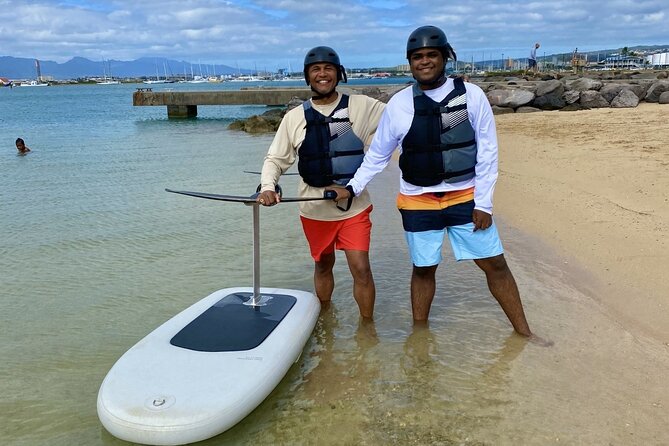
- Beginner-focused progression: belly rides to touch-and-go to standing, at your own speed
- Simulator time first: learn center of gravity and remote control before the water
- Short, structured water runs: three 10-minute sessions add up to about 30 minutes total
- Certified guidance + radios: helmets with radios make communication easier when you spread out
- Good value for first-timers: equipment and safety are included in the $188 price
What an eFoil lesson in Ke’ehi Lagoon is really like
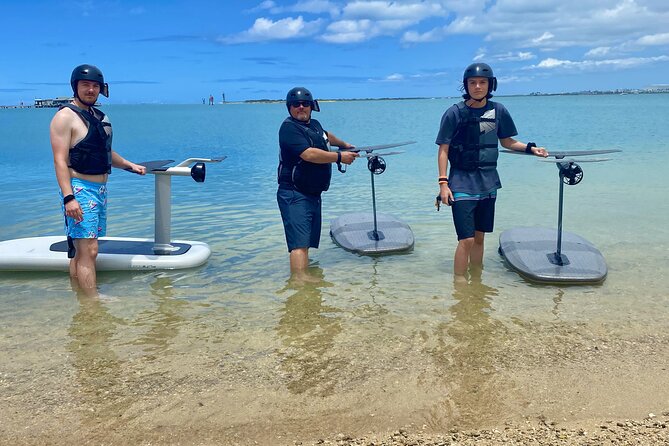
An eFoil (electric hydrofoil) looks like a surfboard until you turn it on. Then the underwater wing creates lift and you start riding above the surface. It’s a modern version of that hoverboard fantasy, with the key difference that the main challenge isn’t strength. It’s balance, body position, and throttle control.
The biggest practical win here is that you’re not thrown into the deep end. The lesson is built like a progression ladder. You start with comprehension land training and safety basics, then you practice the control mechanics on the simulator. Only after you’re comfortable with where your weight goes and how turns work do you move into real water riding.
The tone from the instructors in the feedback is consistent: clear teaching, no wasted time, and a focus on making you comfortable quickly. Ben comes up again and again as the person guiding students through technique, and another instructor name, Jason, also appears helping people get set up and riding smoothly.
You can also read our reviews of more private tours in Oahu

Your 2-hour flow: from safety talk to your first sustained ride
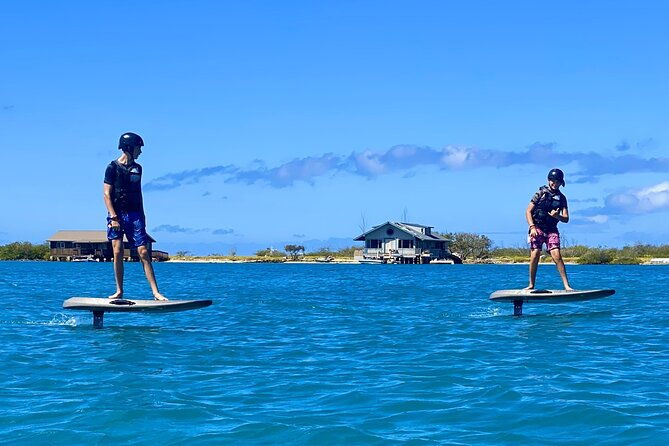
Even though the whole block is about 2 hours, the experience is organized so you get a smart mix of instruction and hands-on riding.
Step 1: Meet up and gear up near Kailua
You start at Hawaii Efoil Experience, 1216 Akumu St, Kailua, HI 96734. The activity ends back at the same meeting point. This matters because you’re not bouncing around different sites. It’s a single base where you get equipped, briefed, and launched.
You also bring the mindset that helps most with eFoil: treat it like learning a board sport, not conquering a machine. The safety equipment is included, and your guide is there to get you into the right starting position.
Step 2: Ground school and safety class (15–30 minutes)
Before you hit the water, you get a land lesson that includes safety training and comprehension teaching. This is where you learn how the system works and how the guide expects you to move and react in the water.
For you as a beginner, this section is valuable because it sets the rules for your ride. Foiling changes how your body behaves on water, and that’s why the early safety talk matters. If something feels confusing later, the odds are good it’s because you rushed this part, so pay attention while you can still ask questions.
Step 3: eFoil Simulator practice (control before lift)
Next comes the simulator, described as a balance board that helps you learn control by shifting your center of gravity. You practice the three riding positions:
- Belly down
- Knee riding
- Standing
The goal isn’t to impress anyone. It’s to get your body to respond correctly. If you’ve skateboarded, wakeboarded, or done kneeboarding, that board balance transfers well. If not, you can still learn, but you’ll likely progress a touch slower.
This simulator step is one reason many first-timers feel like the experience is manageable. You’re learning how to maneuver and how the remote works before you’re dealing with the added challenge of water motion.





Step 4: Water time in three 10-minute runs (about 30 minutes total)
Your total water time is about 30 minutes, divided into three 10-minute water runs per student. That structure keeps the lesson focused and reduces the chance you get overly tired before you’ve found your rhythm.
Each water run is part of the progressive build:
1) Belly rides first
You practice using the remote, turning the board, and riding belly-down. This is where you start learning the feel of control.
2) Knee riding and touch-and-go foiling
Then you move to knee riding. You also start with touch-and-go foiling, which means the goal is short successes while you build confidence with lift.
3) Pop-up to standing, plus e-surfing and turns
After that, you progress to standing and e-surfing, working on turns and learning how to slowly rise into the foiling position.
4) Longer, sustained rides if you nail the earlier steps
Once you’ve mastered touch-and-go foiling, the lesson shifts toward longer, sustained rides. How far you get depends on your speed and the group pace, and that’s a good thing. This kind of training works when you’re not forced to sprint ahead of your body.
The guide’s job is to keep you learning without turning it into a test. The feedback style around Ben points to patient coaching and fast feedback loops, which is exactly what beginners need when balance is the whole game.
Price and value: what $188 buys you on Oahu
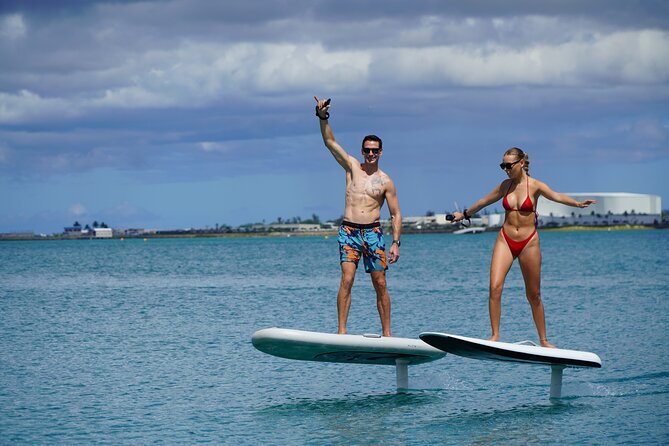
At $188 for about 2 hours, this sits in the “premium activity” category. The key value lever is what’s included.
You get:
- Safety equipment
- A certified guide
- A structured lesson that includes ground school, simulator work, and approximately 30 minutes of water time in three runs
You don’t have to pay extra for instruction quality or basic gear. That’s different from some activities where you pay for the lesson but then feel nickel-and-dimed once you’re there.
There are a couple of add-ons and conditions to keep in mind:
- Photos are available for $39
- If you’re over 205 lb, there’s a Big and Tall charge of $49
- Photos and the weight surcharge affect your final price, so factor those in if they apply
One more value note: the lesson is set up as a group lesson, with one eFoil per 2 students, and a minimum of 2 students required to book. Even so, it’s listed as private for your group, meaning you’re not mixing with random strangers beyond your booking group.
Who this is best for (and who might be better off starting elsewhere)
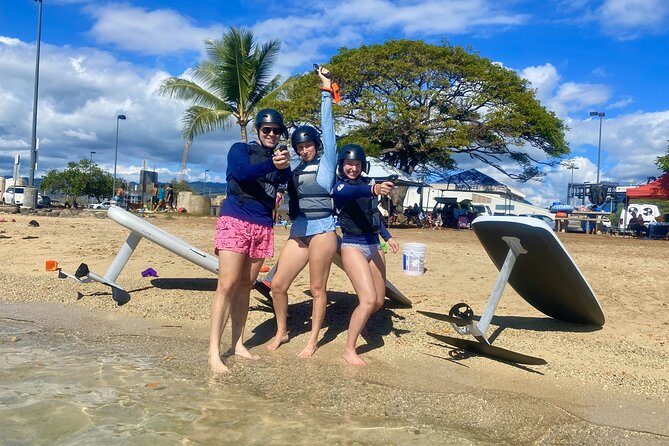
This is designed for ages 13 and up, and the lesson is built for all skill levels. You do not need surf experience. But board-sport balance helps you progress faster, especially when you’re shifting weight and trying to turn with control.
You’ll likely love this if:
- You want a beginner-friendly alternative to surfing
- You want more time riding over the water surface than fumbling around on foam or under-tired conditions
- You like instruction that’s clear and step-by-step, not vague “just try it” coaching
The feedback also hints at a fun side effect: you may see wildlife. One account notes riding over turtles, which tells you the water setting can feel like more than a training pool.
You might want to reconsider if:
- You need lots of long, uninterrupted ride time
- You’re the type who gets frustrated by short learning runs before you’ve found confidence
Remember, this is training. The goal is to get you flying safely, not to rush you into marathon sessions.
Instructors, safety, and the little tech details that matter
The coaching quality shows up in multiple parts of the experience description and in the feedback. Ben is repeatedly mentioned as an excellent instructor who explains technique well and gets students up quickly. Jason also appears as someone who helps with setup and getting people riding.
A specific detail that can change the whole learning experience is communication. Helmets with radios are used, which makes it easier to talk while you’re spaced out on the water. That matters because once you’re flying, you’ll often be slightly away from the guide and focused on your own balance.
That same structure shows up in the teaching style:
- No wasted time
- Clear, efficient instructions
- Patient coaching that makes you comfortable
For you, that means you should show up mentally ready to learn. You don’t have to be fearless. You just need to listen, adjust, and keep trying the next step.
Ke’ehi Lagoon riding: what you can expect to feel
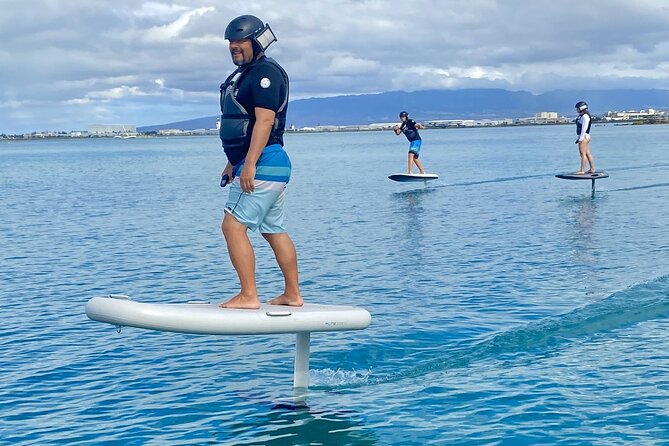
The experience centers on getting lift and learning control. Once the foiling clicks, the sensation is not subtle. It feels like you’re flying over water, and people describe it as fast to get airborne once they’re taught the right technique.
Because the lesson uses a progression ladder, your ride will likely build from:
- floating and controlled turns while belly-down
to
- knee riding and brief lift
to
- popping up into standing and learning the feel of sustained hovering
You may also get glimpses of the surrounding seascape as you rise and move. The water setting is often described as beautiful and safe for training, which is exactly what you want for a first-time electric hydrofoil lesson.
How to plan your day around eFoil lessons
This is one of those activities that benefits from good conditions and a calm schedule.
A few practical tips:
- If you can, leave buffer time around your start so you don’t feel rushed.
- Bring a mindset for short learning bursts. You’ll get better faster if you stay relaxed between runs.
- If you’re doing this on a trip with multiple Oahu stops, consider pairing it with other low-pressure activities the same day. It’s intense to learn balance, even when it feels fun.
Also, since it’s weather-dependent, you want a plan B in the area. If the day gets canceled due to poor weather, you’ll be offered a different date or a full refund.
Should you book this eFoil lesson in Ke’ehi Lagoon?
Book it if you want a beginner-friendly shot at flight with a real teaching plan, not just a rental and a quick safety talk. The structure (ground school, simulator, then three short water runs) is designed to help you progress without guessing. With a certified guide like Ben, plus communication support like radios, you’ll likely feel guided instead of left alone.
Pass or postpone if you’re chasing long, nonstop riding time on your first try, or if you’re traveling when weather is unpredictable and you can’t shift your schedule. Also factor in the final cost if you want photos ($39) or if you’re over 205 lb ($49 surcharge).
If you want my simplest decision rule: if you’re curious about learning to fly on an electric hydrofoil and you can be flexible with weather, this is one of the more straightforward ways to do it on Oahu.
FAQ
How long is the eFoil experience?
The lesson is about 2 hours total, including ground school, simulator practice, and roughly 30 minutes of water time per student.
What’s included in the lesson price?
It includes 1 eFoil per 2 students, 15–30 minutes of ground school, safety equipment, a certified guide, and about 30 minutes of water time per student (split into three 10-minute runs).
Do I need surf experience to do this?
No surf experience is needed. Board-sport balance can help you progress faster, like wakeboarding, kneeboarding, or skateboarding.
How much time will I be on the water?
You’ll get about 30 minutes of total water time, made up of three 10-minute water runs.
What are the age requirements?
The lesson is for students age 13 and up.
Is there any extra charge for weight?
Yes. Students over 205 lb have an additional Big and Tall charge of $49.
What if weather is bad?
The experience requires good weather. If it’s canceled due to poor weather, you’ll be offered a different date or a full refund.
Are photos included?
No. Photos are available for $39.